
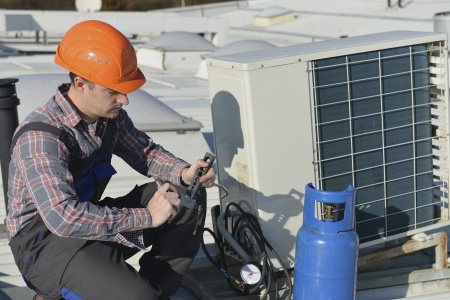
It is the moment every Southern Florida homeowner dreads. Your air conditioner stops working on a sweltering Tuesday afternoon. You call a technician, hoping for a simple fix, but instead, you receive a quote for a major repair that costs nearly as much as a used car. Suddenly, you are faced with a difficult financial decision: Do you patch up the old system and hope it lasts another year, or do you bite the bullet and invest in a brand-new installation?
This “Repair vs. Replace” dilemma is common in our region, where the harsh climate ages equipment faster than the national average. While the upfront cost of a new system can be daunting, pouring money into a dying unit is often throwing good money after bad. Making the right choice requires removing the emotion from the situation and looking at the math, the age of your equipment, and the changing landscape of HVAC technology.
The “50% Rule” and the 10-Year Mark
In the HVAC industry, we often guide homeowners using the “50% Rule.” The logic is simple: If the cost of the repair is 50% or more of the cost of a new system, you should replace it. For example, if you need a new compressor that costs $1,800, and a new unit installed is $5,000, that repair is 36% of the replacement cost. It might make sense to repair if the unit is young.
However, age is the multiplier. In Florida, the average life expectancy of an AC unit is 10 to 12 years (compared to 15-20 in the north). If your unit is over 10 years old and requires a major repair, replacement is almost always the smarter financial move. An older unit is likely to have another component fail soon after the first one is fixed. Consumer finance resources like The Balance suggest multiplying the age of the unit by the repair cost; if the number exceeds $5,000, replace it.
The Refrigerant Reality: R-22 is Gone
Another critical factor in the decision is the type of refrigerant your system uses. If your unit was manufactured before 2010, it likely uses R-22 (often known by the brand name Freon). As of 2020, the production and import of R-22 have been completely banned in the United States due to environmental regulations.
This means that if your older unit has a leak, the only R-22 available to refill it is recycled stock, which has skyrocketed in price. Fixing a leak and recharging an R-22 system can cost hundreds, sometimes thousands, of dollars. Investing that money into a 15-year-old system is a poor value proposition. New systems use eco-friendly refrigerants (like R-410A or the newer R-454B) that are widely available and much cheaper to service. The EPA provides detailed timelines on these phase-outs, helping homeowners understand why maintaining an old R-22 unit is becoming financially unsustainable.
Financing and Energy Savings
Finally, consider the “invisible” cost of keeping your old unit: your electric bill. AC technology has leaped forward in the last decade. A 12-year-old builder-grade unit might operate at 10 SEER (Seasonal Energy Efficiency Ratio). A modern high-efficiency unit can operate at 16, 18, or even 20 SEER.
Upgrading from 10 SEER to 16 SEER can reduce your cooling costs by nearly 40%. In Southern Florida, where cooling makes up the bulk of our utility bill, these savings can essentially make the monthly payment on a new unit “free” over time. Many manufacturers and local utility programs offer rebates or 0% financing options that make the upfront sting of installation much more manageable.
Your Southern Florida Experts for Air Conditioning Installation
Don’t throw your hard-earned money into a money pit. We offer honest assessments to help you decide if your system is worth saving or if it’s time to upgrade. If you choose to replace, we provide flawless installation of the latest high-efficiency systems tailored to your home. Trust Best Air Solutions for transparent advice and quality work. Explore our Air Conditioning Installation options or request a free quote via our Contact Us page.
Related service from Best Air Solutions: AC repair in South Florida.